
At British Steel, we’re committed to sustainable steelmaking. Steel is vital to modern economies and over the coming decades, global demand is expected to grow to meet rising social and economic welfare needs.
As the world’s most recycled material, steel plays a central role in transitioning to a low-carbon, circular economy. Reviewing our processes and investing in new technology will boost our contribution to significant decarbonisation.
Life Cycle Assessment
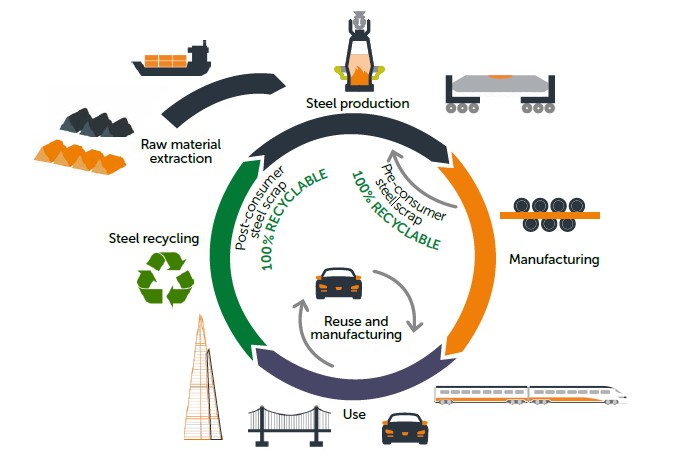
Steel from the blast furnace route can be easily recycled through the Electric Arc Furnace (EAF) or Basic Oxygen Steelmaking (BOS) route later in its life. In this way a symbiosis between the world’s 2 leading steelmaking routes exists.
Our Environmental Product Declaration (EPD) for rail, sections and semi-finished long products includes the future benefit of the 100% recyclability of steel in the form of a module D assessment. Downstream uses of the British Steel EPD should use module D when evaluating steel products to reflect the unique properties of steel as a ‘multi-generational’ material and a material fully embedded in circular economy thinking.
Supporting Your Scope 1 Emission Reductions
Steel is a fast, safe construction material. Steel frames can be manufactured offsite in a safe factory environment. Reducing assembly time on site (7% to 15% less) means lower costs and less disruption to the local community.
Steel construction products can help deliver reductions in scope 1 and 2 carbon emissions for the construction sector.
Through research and development, our innovative S460M structural steel grade can offer a much reduced weight, offering an embedded carbon reduction for your building project.
There is generally no site waste, but any that occurs can be returned to the steel supply chain and multi-cycled. Due to the strength of steel, buildings can be designed with long spans to offer flexible design solutions and extended life.
Process Gases: Reduced use of natural gas
At our Scunthorpe site, we generate process gases as by-products of blast furnace ironmaking and basic oxygen steelmaking. The priority is to maximise the use of process gases as fuel for other combustion processes within the site, such as steel re-heating prior to hot rolling and steam raising. In this way, we can avoid the import of other fuels such as natural gas and propane.
Recycled Content
We use the methodology from the international standard ISO 14021 to measure and assess the recycled content of our steel products. Maximising recycled content decreases our scope 1 emissions. At present 25% to 30% is the maximum recycled content achievable through the BOS route.
In the table below we present our recycled content figures from 2020 to 2025:
| 2020 | 2021 | 2022 | 2023 | 2024 | 2025 | |
|---|---|---|---|---|---|---|
| Pre-consumer recycled content | 9.10% | 13.60% | 17.80% | 19.40% | 25.0% | 21.6% |
| Post-consumer recycled content | 16.00% | 11.90% | 5.70% | 0.90% | 0.20% | 0.70% |
| Recycled content according to ISO 14021 | 25.20% | 25.60% | 23.50% | 20.30% | 25.20% | 22.3% |
Responsible Sourcing
Our customers recognise the benefits of sustainable development, both in meeting government guidelines, and improving social and environmental performance.
British Steel is certified to a good rating for the Environmental and Sustainability Standard BES 6001 Responsible Sourcing of Products, meaning our customers can be confident they are working with a supplier who is committed to sustainability and that it is embedded into our company ethos.
Through this external validation, customers are able to benchmark our performance and demonstrate they are sourcing products from a responsible supplier. Designers and developers use our products in the knowledge that they can secure additional credits under sustainability schemes, such as BREEAM, BREEAM Infrastructure (previously CEEQUAL) and LEED.
The certification covers our Teesside, Scunthorpe and Skinningrove sites, where we manufacture rail, sections, wire rod, special profiles and semi-finished products.
Sustainable Products: Higher Strength and Durability
Our dedicated New Product Development and Research & Development teams tailor the properties of steel to offer sustainable solutions.
For example, our industry award-winning HP335 rail delivers energy-efficient transportation of people and goods. Extended in-service monitoring shows track life can be more than doubled while also reducing maintenance requirements. In addition to the safety, cost and environmental benefits, using HP335 means greater network availability, delivering increased and better service on rail networks. Our portfolio of rail products can ensure the appropriate grade is utilised in the correct application to optimise rail life and performance, hence supporting a lower carbon transport network.
Our customers strive to optimise the life of machinery, while making it safer, more cost-effective and more energy efficient. Innovations such as higher strength crane rail offer better durability in service with the potential to use lighter sections, reducing installation and transport costs.
High-strength steel cutting edges and track shoes also offer extended life and improved durability for the materials handling industry.
Local Sourcing: Reduced Transport Emissions
By working with us, our customers positively influence the carbon footprint of their supply chain.
Steel transported within the UK produces 50% less CO2 than steel sections sourced from the EU. Supply routes can offer total emissions of less than 10kg CO2 per tonne of steel in some cases – 4 times less than steel sourced from mainland Europe. The average distance UK manufactured steel sections are transported to our customers is less than 150km.
Resource Use and Waste Management
Integrated steelmaking requires large amounts of raw materials such as iron ore and coal. It’s vital that we continue to optimise our consumption of these raw materials by minimising waste and ensuring that our by-products meet tight quality control requirements so that they can be used in other industry sectors. As a result of continued improvements in material management, well over 90% of all residue material produced across the site is subject to internal recirculation or external recovery / recycling.
Our most significant by-product is blast furnace slag. This is a valuable raw material for the concrete and construction industry, where it is used as a clinker substitute, thus reducing mineral extraction and CO2 emissions further.
Steelmaking slag is used extensively in civil engineering and agricultural applications.
In addition, iron and steelmaking slags sequester atmospheric CO2 through natural processes. Even after the manufacturing process, our by-products can help to off-set CO2 emissions.
In line with British Steel’s objective to reduce waste to landfill, we’ve enacted a number of waste reduction strategies at our Scunthorpe site. Applying the waste hierarchy, we encourage re-use of materials such as scale and gas-cleaning residues within site processes.
A wide range of technologies such as oxide briquettes, hydro-cyclones, re-use of oily residues and de-watering facilities have been implemented to recover materials back into the process.
Transport Impacts
The impacts associated with the transportation of our raw materials to our manufacturing sites, delivery of our products to customers, and business travel are relatively small when set against the footprint of our manufacturing operations.
Nevertheless, we have an environmental policy commitment to reduce the environmental impact of our operations and products through the adoption of sustainable practices. For this reason, we seek to measure our transport impacts and to progressively reduce them.
A series of strategies have been developed to deliver this objective, for example:
- Enacting shift from road to rail. Optimise weight of load where this is not possible
- Link outward journeys with return legs to minimise empty running rate
- Improve the efficiency of the contracted and subcontracted haulage fleet
Water Use
At our Scunthorpe site we’re currently achieving best practice with regards to water consumption at an integrated steelworks and, as such, can be considered to be a steel industry benchmark in this area.
Consumption per tonne of steel manufactured is below that associated with the application of best available techniques (BAT) according to the EU’s BAT reference document for iron and steel.
British steel environmental product declaration (EPD) for rails and sections 31 July 2026
The British Steel EPD dated 31st July 2026 refers to data collected from calendar year 2025 operations. The EPD has been produced using the latest World Steel Association (worldsteel) methodology and reflects changes in worldsteel contribution factors and reconfiguration of British Steel assets. Notable GWP (Global Warming Potential) factors to consider in comparison with the previous EPD dated 24th January 2020 include:
1) Revision of worldsteel Expanded Indicators methodology
The World Steel Association’s GWP reporting now includes direct and upstream methane and nitrous oxide emissions, increasing GWP for typical BF-BOF production by 0.32 t CO₂eq / t of steel. As described by worldsteel:“This is not an actual increase in emissions, but a reflection of the improved accounting approach and increased coverage.”
See below extract from the most recent global worldsteel GHG emissions intensity report:
(Sustainability Indicators Report 2025 – worldsteel.org)
CO2, GHG, and energy emissions intensity
Updating worldsteel’s CO2 emissions reporting – expanded scope, now greenhouse gas emissions (GHG) reporting
For the first time, our published industry and route-level CO2 intensity indicators go beyond carbon dioxide (CO2) to also cover methane (CH4) and nitrous oxide (N2O), as well as emissions from upstream mining activities. We are also updating our emission factors.
These changes are implemented to better align our reporting with the GHG Protocol, ISO standards, worldsteel’s own life cycle assessment (LCA) framework, and the expectations set out in SBTi guidance. They represent an important step forward in transparency and credibility.
Impact on reported data
The effect of these improvements is that reported emissions per tonne of steel is higher. This is not an actual increase in emissions, but a reflection of the improved accounting approach and increased coverage. Importantly, applying these revised factors across the entire time series does not alter the industry’s long-term trajectory. Our historical performance trend remains unchanged.
For more details on our updated calculation, please refer to our policy paper “Climate change and the production of iron and steel” on worldsteel.org.
| BF-BOF | Scrap-EAF | DRI-EAF | Global | |
| (Scrap use – 10%) | (Scrap use >70%) | (Scrap use <30%) | ||
| Original Indicator (CO2 emissions intensity) | 2.34 | 0.69 | 1.47 | 1.92 |
| Direct CH4 and N2O (GWP 100) | 0.09 | <0.01 | <0.01 | – |
| Upstream mining CO2 only | <0.01 | <0.01 | 0.01 | – |
| Upstream mining CH4 and N2O (GWP 100) | 0.23 | 0.03 | 0.18 | – |
| Expanded indicator (GHG emissions intensity) | 2.66 | 0.71 | 1.66 | 2.18 |
2) Revision in worldsteel emission factors for imported coke resulting in a 70% increase in reported GWP, whilst also British Steel has switched to 100% imported coke
A revision in worldsteel emission factors report that imported coke production GWP has increased by 70% from 0.597 to 1.01 t CO₂eq / t. During the same reporting period British Steel closed the Scunthorpe coke ovens (2023) and has since been operating with 100% imported coke. The 70% increase in the GWP of imported coke, combined with the switch to 100% imported coke, have both contributed to an increase in the overall GWP for the steel rails and sections EPD.
3) Blast furnace recovery
It is widely known that during the 2025 reporting period British Steel’s blast furnace operations suffered extended outage periods, and that the critical business focus was to return the UK’s remaining blast furnaces to stable operations. The lost output arising from the blast furnace challenges contributed to an overall increase in the coke required per tonne of liquid steel produced, by approximately 30% vs normal levels. British Steel would expect the coke utilisation per tonne of liquid steel to reduce as operations and output recover to normal levels.
GLOSSARY
BOS: Basic Oxygen Steelmaking involves making steel through oxidation by injecting oxygen through a lance above a molten mixture of liquid iron and scrap steel
EAF: an Electric Arc Furnace melts steel scrap using the heat generated by a high power electric arc. During the melting process, elements are added to achieve the correct chemistry and oxygen is blown into the furnace to purify the steel
Module D: an Environmental Product Declaration (EPD) is an independently verified and registered document that communicates transparent and comparable information about the life-cycle environmental impact of products
Scope 1: Scope 1 emissions are direct emissions from owned or controlled sources
Scope 2: Scope 2 emissions are indirect emissions from the generation of purchased energy
Scope 3: Scope 3 emissions are all indirect emissions (not included in Scope 2) that occur in the value chain of the reporting company